Game messages and logs
Messages from the game logic
The game logic sends no finished text. A log line, an offer's label and a refusal's reason are each a message: a key in the catalogs and the values of its placeholders, built with msg!. Each viewer's client formats it in their own language.
table.log(msg!("log.marks", cell = space_id.as_str()));
{ "log.marks": "{player} marks cell {cell}" }
{player}is the line's player. Boardweaver fills it, so amsg!never passes it. Place it where the language needs the name, or leave it out of a message that names no one.- A value is a number, text, a seated player, another message or a link. The table of values is in Log lines.
- The build checks each
msg!whose key is a string literal against the default catalog. A key built at run time is not checked, and shows as its key when no catalog has it.
Log lines
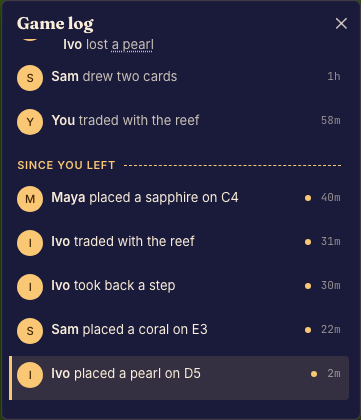
table.log(line) adds a line to the step's log, which every viewer sees in the match's history. A step may write any number of lines, and so may setup for the opening. A line is a message: a key in the game's catalogs (Text in the player's language) and the values of its placeholders. Each viewer's client shows it in their own language. Build a message with msg! and log it as a line by the seat that took the step:
table.log(msg!("log.marks", cell = space_id.as_str()));
table.log(msg!("log.plays", card = link(face.clone(), msg!(format!("card.{face}")))));
Write each message in the catalog of the game's default locale, such as /src/i18n/en.json:
{
  "log.marks": "{player} marks cell {cell}",
  "log.plays": "{player} plays {card}"
}
Boardweaver fills {player} with the line's player, shown by name. Leave {player} out of a message that names no one. Import msg, link and player from boardweaver_sdk.
The build checks every msg! whose key is a string literal against the default catalog: a key the catalog lacks, a value its message has no placeholder for, a placeholder no value fills, a tag such as <b>, or a value named player does not compile, and the error points at the msg!. A key built at run time, such as msg!(format!("card.{face}")), is not checked, so a missing one shows as its key.
A placeholder takes one of these values:
| Value | Write | Shows |
|---|---|---|
| a number | count = 2, an i64, i32, u32 or usize |
the number in the viewer's language. Count with it in a plural: {count, plural, one {# card} other {# cards}} |
| text | name = "Ys", a &str or a String |
the text as it is, in every language, such as a name a player typed |
| a seated player | target = player(id) |
the player's name |
| another message | card = msg!("card.knight") |
that message in the viewer's language, such as a card's name |
| a link | card = link(key, msg!("card.knight")) |
the message as a control that useLogLinks hears. key is your own string, such as a card id |
To give a line another player, no player or a kind, build it with LogLine::new(message) and these methods. Import LogLine and LinePlayer from boardweaver_sdk.
| Method | Sets | Default |
|---|---|---|
.player(LinePlayer::Seat(id)) |
whose line it is, which {player} names: LinePlayer::Actor, LinePlayer::Seat(id) or LinePlayer::None |
LinePlayer::Actor, the seat that took the step |
.kind("combat") |
a label the client styles the line by: 1 to 32 characters of a-z, 0-9 and - |
none |
table.log(LogLine::new(msg!("log.round", round = 2)).player(LinePlayer::None));
- Every viewer reads every line, whatever they may see of the state. Name only public facts: "takes a card", never the card. This holds for the message, its values, the link keys, the kind and the player.
- The game logic knows seat ids, not names. Pass a seat with
player(id), and Boardweaver shows its name. - A message key that no catalog has shows as the key. The build catches a literal one.
- A line with
LinePlayer::Nonewhosemsg!has a literal key and a message that places{player}panics, since there is no player to fill it. With a key built at run time, the line shows as its key instead. - Write a line in each step that players should see as its own row in the game log. A step that writes no line joins another row (Other players' steps).
player(id)andLinePlayer::Seat(id)name a seated player. Any other id panics.- Boardweaver fills
playeritself. Amsg!that passes a value namedplayerdoes not compile, and aMessagegiven one by.argpanics. LinePlayer::Actoron the opening, which no seat took, has no player. A message that uses{player}on a line with no player shows as its key.- A step's lines have limits (Builds, limits and errors). Going past one panics.